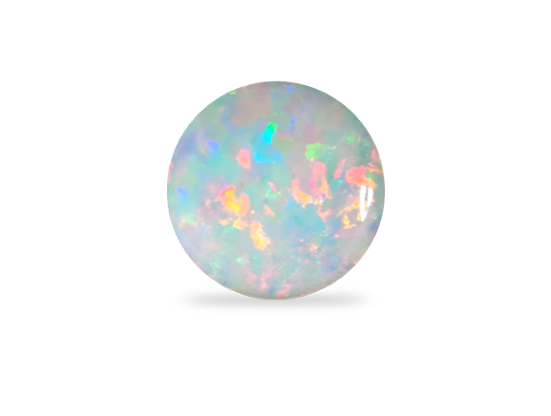
Opal is the stone that holds a whole rainbow, with flashes of red, green, blue and gold that move and change as you turn it. No two opals look alike, so every opal piece is truly one of a kind. It is the October birthstone and a softer gem that rewards a little care. We set natural opal in 925 sterling silver and solid gold at our studio on Sukhumvit 71, Bangkok.
This page covers what opal is, the main kinds of opal, how it compares with other October and glowing stones, how to wear and care for it, what makes a good stone, where opal comes from, how to see the stones at our shop, and how to order in Bangkok or anywhere in Thailand.
What opal is
Opal is silica, the same building block as quartz, but with water held inside and no crystal structure. Most opal contains a few percent water, and some much more.
In precious opal, tiny spheres of silica are packed in neat rows. When light passes between them it splits into pure spectral colors, the same way light splits on the back of a CD. This is called play of color. Larger spheres can produce red and orange, which is why red flashes are the rarest and most valued. Opal without this effect is called common opal and can still be a pretty colored stone.
Opal is often protected or improved. Thin slices are glued to a dark backing as doublets, or capped with clear quartz as triplets. Some opal is smoke or sugar treated to darken the body, and some is impregnated with oil, wax or resin. Every stone we set is natural, opal included, and if a stone has had any treatment or is assembled we tell you before you order.
Opal facts at a glance
- Color: white, black, gray, clear, orange and red bodies, with flashes of every spectral color
- Mineral: hydrated silica with no crystal structure
- Hardness: 5.5 to 6.5 on the Mohs scale
- Treatment: doublets, triplets, smoke, sugar and impregnation exist; all disclosed before you order
- Best for: pendants and earrings, and rings in a protective setting worn with care
- Care: wipe with a damp soft cloth; no ultrasonic, steam, harsh chemicals or sudden heat
- Price: depends on the quality and carat you choose; we quote before you order
Kinds of opal
White opal has a light, milky body with soft pastel flashes. It is the most familiar and most affordable precious opal.
Black opal has a dark body that makes the colors glow intensely. It comes mainly from Lightning Ridge in Australia and is the most valuable kind.
Boulder opal forms in thin seams inside ironstone and is cut with its brown host rock left on the back, which gives it strength and a dark background.
Crystal opal is clear to see-through, with colors that seem to float inside the stone.
Fire opal has a bright yellow, orange or red body, mostly from Mexico. It may show play of color or none, and clear orange fire opal is often faceted.
Ethiopian opal, mainly from the Welo region, often has strong flashes at a friendly price. Much of it absorbs water and turns clear for a while when wet, so it should not be soaked.
Opal and other stones
Tourmaline is the other October birthstone. At 7 to 7.5 on the Mohs scale it is harder and easier to wear every day, and it comes in every color from pink to green. If you want an October stone for a daily ring, tourmaline is the practical pick; if you want color that moves, choose opal.
Moonstone has one calm blue or white glow that rolls across the stone instead of opal’s patches of many colors. It is a little harder, at 6 to 6.5.
Labradorite shows bold blue and green flashes on a gray body. It looks dramatic like black opal and is far more affordable, though its flashes appear only at certain angles.
How to wear and care for opal
Opal is softer than most gems and can crack if knocked or if it dries out or heats up too fast. It is perfect in pendants and earrings. In a ring, choose a bezel or a setting with a protective rim, wear it for evenings and special days, and take it off for the gym, cooking, cleaning, gardening and swimming.
Clean opal by wiping it with a soft cloth dampened with mild soapy water, then dry it. Never use an ultrasonic cleaner or steam, and keep it away from bleach, perfume sprays and strong heat. Doublets and triplets should not be soaked, because water can loosen the glue. Bangkok’s warm, humid air suits opal well; just avoid leaving it in a hot car or bright sun for hours. Store it on its own in a soft pouch. If it ever needs a polish or a check of the setting, bring it to our shop. Maintenance is free on jewelry we made.
What makes a good opal
Play of color comes first. Look for bright, strong flashes that cover the whole face and show from many angles. Red and orange flashes are the rarest, then green, then blue.
Pattern adds character. Broad flashes, small pinfire points and rare named patterns such as harlequin all change the value. Pick the one you love.
Body tone runs from white to black. A darker body makes colors look stronger and usually means a higher price.
Clarity and soundness matter for durability. A good opal has no cracks, called crazing, and few patches of plain color.
Solid or assembled is the last question. A solid opal is one piece. A doublet or triplet gives a strong look for less but needs to stay dry.
Where opal comes from
Australia has produced most of the world’s precious opal for more than a century, from black opal at Lightning Ridge to white opal at Coober Pedy and boulder opal in Queensland. Ethiopia is now a major source too, and Mexico is famous for fire opal. More comes from Brazil and the United States.
If you want to know the origin of a particular stone, ask us: we offer certified stones, and an uncertified stone can be sent to a gem lab for a report at extra cost.
The October birthstone
Opal is one of the two birthstones for October, together with tourmaline, and the traditional gem for a fourteenth wedding anniversary. It makes a memorable birthday gift because every stone is unique. Our birthstone chart shows all twelve months if you are building a ring or bracelet for the whole family.
See opal at our shop in Bangkok
Play of color is the reason to come in person, because the flashes in an opal change with every tilt and no photo can follow them. Mention opal in your booking and extra stones will be waiting for you, with lighter and darker bodies, in a range of sizes.
Walk in any time we are open, or book ahead so Yaron is there to help with the stone, the design and the metal, from 925 silver and gold plating to solid 9K, 14K or 18K gold.
Since no two opals are alike, you may simply want to own the one stone that caught your eye. You can buy it loose with no jewelry needed, and we would be very happy to set it for you.
See opal with Yaron
TOANOI House, 259/80 Phibunwet Village, Sukhumvit 71, Bangkok. Monday to Friday 9:30 to 17:00 and Saturday 10:00 to 15:00. We speak Thai, English and Japanese.
Not in Bangkok? Message us and we will send photos and prices of the opal we have.
Opal questions we get
Is your opal natural?
Yes. Every gemstone we set is natural, opal included. Some opal is assembled as a doublet or triplet, or treated with smoke, sugar, oil or resin, and if a stone has had any treatment we tell you before you order. We are a member of the Thai Gem and Jewelry Traders Association.
Is opal too soft for a ring?
Opal is 5.5 to 6.5 on the Mohs scale, so it is best in a ring with a protective setting worn with care, or in a pendant or earrings. Take it off for sport, cooking and cleaning.
What is the difference between a solid opal and a doublet?
A solid opal is one piece of opal. A doublet is a thin slice of opal glued to a dark backing, and a triplet adds a clear quartz cap. Both look bright for less but should not be soaked in water.
Can opal get wet?
A solid opal can be wiped with a damp cloth and survives hand washing, but do not soak it. Doublets, triplets and Ethiopian opal should be kept dry.
What is the October birthstone?
October has two birthstones, opal and tourmaline. Opal shows moving flashes of color, and tourmaline is a harder stone in many colors that suits everyday rings.
How much does opal jewelry cost?
It depends on the quality and carat of the stone you choose, and on the metal. We give you the price before anything is made.
Can I buy just the stone?
Yes. Opal is sold as a single loose stone too, and you are under no obligation to order a setting. Whenever you are ready, now or later, we are glad to set it in a pendant, earrings or a ring.
How long does a opal piece take?
7 to 10 working days from your order, because the stones are already here in our shop, then 1 to 3 working days for delivery inside Thailand. We also ship abroad by FedEx.
Every opal piece is made to order by our team in Bangkok in 925 sterling silver or solid gold, with a 3-year warranty, free maintenance and free shipping across Thailand.
