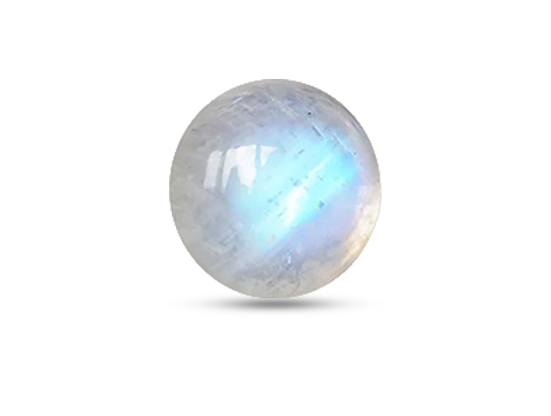
Moonstone is the stone with a soft light that seems to float just under its surface, like moonlight on water. It is one of the June birthstones, a gentle and romantic stone that looks lovely in both silver and gold. Because it needs a little more care than harder gems, it shines brightest in pendants, earrings and rings worn with some attention. We set natural moonstone in 925 sterling silver and solid gold at our studio on Sukhumvit 71, Bangkok.
This page covers what moonstone is, what makes it glow, how it compares with similar stones, how to wear and care for it, what makes a good stone, where moonstone comes from, how to see the stones at our shop, and how to order in Bangkok or anywhere in Thailand.
What moonstone is
Moonstone is a feldspar, the most common mineral family in the earth’s crust. Most fine moonstone is orthoclase feldspar, sometimes called adularia. As the crystal cools, two kinds of feldspar separate into extremely thin layers stacked inside the stone.
Those layers scatter light, and the scattered light is what you see as the floating glow. Gemologists call it adularescence. When the layers are very thin the glow is blue, which is the most prized look. Thicker layers give a white or silvery sheen. The body of the stone can be colorless, white, gray, peach, or a light brown or green.
To show the glow, moonstone is almost always cut as a smooth dome called a cabochon. Some stones also show a cat’s eye line, and rare ones a faint star.
Moonstone is normally not treated. Every stone we set is natural, moonstone included, and if a stone has had any treatment we tell you before you order.
Moonstone facts at a glance
- Color: colorless, white, gray, peach and light brown, with a blue to white floating glow
- Mineral: feldspar, mostly orthoclase
- Hardness: 6 to 6.5 on the Mohs scale
- Treatment: normally untreated
- Best for: pendants, earrings and rings worn with care
- Care: warm soapy water and a soft cloth; no ultrasonic or steam cleaning
- Price: depends on the quality and carat you choose; we quote before you order
Moonstone, rainbow moonstone and other glowing stones
Rainbow moonstone is a trade name for a white labradorite, a related feldspar. Instead of one blue glow it flashes blue, violet, green and gold. It is just as pretty and is usually more affordable. We always tell you which one you are looking at.
Labradorite itself is gray to dark with bold flashes of blue, green and gold. It is the same family, with a stronger, more dramatic look.
Opal shows patches of many colors that change as you move it, called play of color. Moonstone has one calm glow that rolls across the surface. Opal is a little softer and needs even more care.
White chalcedony and milky quartz look similar at a glance but have no floating light. If the glow does not move when you tilt the stone, it is not moonstone.
How to wear and care for moonstone
At 6 to 6.5 on the Mohs scale moonstone is softer than quartz, and it has cleavage, so a hard knock can crack it. It is ideal in pendants and earrings. In a ring it is fine for occasional wear or a careful daily wearer, best in a bezel or a setting with a raised rim around the stone. Take it off for the gym, cooking, cleaning and swimming.
Clean moonstone in warm soapy water with a soft cloth, then rinse and dry. Do not use an ultrasonic cleaner or steam, and keep it away from sudden heat. Store it on its own so harder stones and dust cannot scratch the dome. Over years a moonstone can lose a little of its polish; a quick repolish brings it back. If it ever needs a polish or a check of the setting, bring it to our shop. Maintenance is free on jewelry we made.
What makes a good moonstone
The glow comes first. The best moonstones show a strong blue glow that covers the whole face of the stone and moves as you turn it, seen from every angle and not only from one side.
Transparency is next. A clear, almost glassy body makes the glow look like it floats in the air. Milky or cloudy stones have a softer, whiter sheen and cost less.
Clarity matters because the stone is see-through. Look for few visible inclusions. Small internal lines called centipedes are typical of moonstone and are normal in smaller amounts.
Cut must be centered on the glow. A well cut cabochon is domed high enough to gather the light and shows the sheen right in the middle when you look straight at it.
Size plays its part. Clear blue moonstones over a few carats are uncommon, while white and peach moonstones are easier to find in larger sizes.
Where moonstone comes from
Sri Lanka is the classic source of fine blue moonstone and has produced it for centuries. India gives large amounts of moonstone in white, peach and gray, as well as much of the rainbow moonstone. More comes from Myanmar, Madagascar and Tanzania.
If you want to know the origin of a particular stone, ask us: we offer certified stones, and an uncertified stone can be sent to a gem lab for a report at extra cost.
The June birthstone
Moonstone is one of the birthstones for June, together with pearl and alexandrite. Of the three it is the gentle middle choice: more affordable than alexandrite and easier to find in many shapes than pearl. It is a lovely birthday gift and a stone for a family ring where each person gets their own month. Our birthstone chart shows all twelve months if you are building a ring or bracelet for the whole family.
See moonstone at our shop in Bangkok
That floating glow only makes sense when it moves, so tilt the stone and watch the light roll across it. A clear body makes the glow seem to hang in the air. When booking, mention moonstone and we will gather more in white, peach and gray body colors and several sizes.
Walk in any time we are open, or book ahead so Yaron is there to help with the stone, the design and the metal, from 925 silver and gold plating to solid 9K, 14K or 18K gold.
A good moonstone is a pleasure just to tilt in the light, and you can buy one loose without ordering jewelry. We would be very happy to make a piece too, such as a pendant or earrings.
See moonstone with Yaron
TOANOI House, 259/80 Phibunwet Village, Sukhumvit 71, Bangkok. Monday to Friday 9:30 to 17:00 and Saturday 10:00 to 15:00. We speak Thai, English and Japanese.
Not in Bangkok? Message us and we will send photos and prices of the moonstone we have.
Moonstone questions we get
Is your moonstone natural?
Yes. Every gemstone we set is natural, moonstone included, and moonstone is normally not treated. If a stone has had any treatment we tell you before you order. We are a member of the Thai Gem and Jewelry Traders Association.
What makes moonstone glow?
Very thin layers of two kinds of feldspar inside the stone scatter light, which gives the soft floating glow called adularescence. Thinner layers give a blue glow, thicker ones a white sheen.
Is rainbow moonstone a real moonstone?
Rainbow moonstone is a trade name for a white labradorite, a feldspar closely related to moonstone. It is a natural stone with colorful flashes, and we always tell you which one you are buying.
Can I wear a moonstone ring every day?
You can with some care. Moonstone is 6 to 6.5 on the Mohs scale and can crack from a hard knock, so choose a protective setting and take it off for sport, cooking and heavy work.
How much does moonstone jewelry cost?
It depends on the quality and carat of the stone you choose, and on the metal. We give you the price before anything is made.
Can I buy just the stone?
Yes. Moonstone can be bought as a loose stone with no jewelry attached. When you want it set, now or in the future, we are happy to make a protective bezel or a setting with a raised rim.
How long does a moonstone piece take?
7 to 10 working days from your order, because the stones are already here in our shop, then 1 to 3 working days for delivery inside Thailand. We also ship abroad by FedEx.
Every moonstone piece is made to order by our team in Bangkok in 925 sterling silver or solid gold, with a 3-year warranty, free maintenance and free shipping across Thailand.
