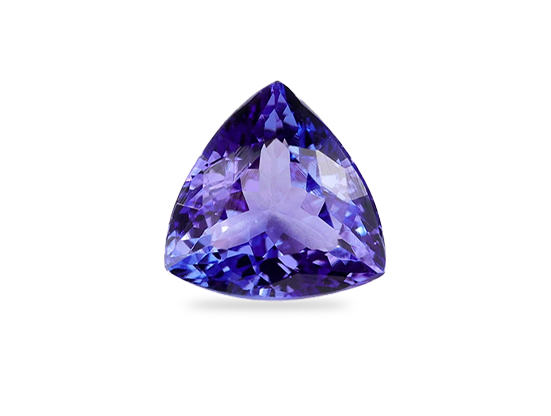
Tanzanite is a velvety violet blue gemstone found in only one place on earth, a small area of hills in northern Tanzania. Turn it in your hand and it shifts between blue and purple, a play of color that no other popular gem quite matches. It is one of the December birthstones and a modern classic, discovered only in the 1960s. We set natural tanzanite in 925 sterling silver and solid gold at our studio on Sukhumvit 71, Bangkok.
This page covers what tanzanite is, why it changes between blue and violet, how it compares with other blue and purple gems, how to wear and care for it, what makes a good stone, how to see the stones at our shop, and how to order in Bangkok or anywhere in Thailand.
What tanzanite is
Tanzanite is the blue to violet variety of the mineral zoisite, a calcium aluminum silicate. Its color comes from a small amount of vanadium in the crystal. Gem quality zoisite of this color was found in the Merelani Hills near Arusha in 1967, and the jeweler Tiffany and Co. gave it the name tanzanite after its only home country.
Most tanzanite comes out of the ground a brownish or yellowish violet. Gentle heating removes the brown and brings out the blue and violet that people know. Heating is standard for tanzanite, almost every stone on the market has been heated, and the result is stable and permanent. A small number of stones come out of the ground already blue and need no heat. Every stone we set is natural, and if a stone has had any treatment beyond the usual heating we tell you before you order.
At 6 to 7 on the Mohs scale, tanzanite is softer than sapphire and topaz, and it has one direction of perfect cleavage. It is a stone to wear with some care rather than one to knock against a desk every day.
Tanzanite facts at a glance
- Color: violet blue, from bluish violet to deep blue, with purple flashes
- Hardness: 6 to 7 on the Mohs scale
- Treatment: heated as standard; stable and permanent
- Best for: pendants, earrings and rings worn for occasions or with care
- Care: warm soapy water and a soft brush; no ultrasonic cleaners, steam or sudden heat
- Price: depends on the quality and carat you choose; we quote before you order
Why tanzanite shifts between blue and violet
Tanzanite is strongly pleochroic. That means it shows different colors when you look at it from different directions through the crystal. A rough crystal can show blue, violet and a reddish or brownish tone along its three directions. After heating, the blue and violet remain and the brownish tone mostly disappears.
The cutter chooses how to orient the stone. Cut one way, a tanzanite faces up more blue; cut another way, it looks more purple. In a finished stone you see both colors as you move, a blue body with violet and purple flashes. Light changes it too: tanzanite tends to look bluer in daylight and more violet under warm indoor light.
Tanzanite and other blue and purple gems
Blue sapphire is much harder at 9 and the better choice for a ring you never take off. Fine sapphire usually costs more, and its color is a purer blue without the violet flash.
Iolite has a similar violet blue and also changes tone as you turn it. It is harder at 7 to 7.5 and costs much less, though it is usually lighter and seldom as rich as fine tanzanite.
Amethyst is purple quartz, 7 on the Mohs scale. It is a true purple rather than a blue violet, and far more affordable.
Blue topaz shares December with tanzanite. It is harder at 8 and costs less, with a clear blue and no violet.
How to wear and care for tanzanite
Tanzanite is at its best in pendants and earrings, where it rarely gets knocked. It also makes a beautiful ring, and many people choose it for engagement or anniversary rings. For a ring, we suggest a setting that protects the stone, such as a bezel or a halo, and taking it off for the gym, housework, swimming and heavy work.
Clean it in warm soapy water with a soft brush, then rinse and dry. Never use an ultrasonic cleaner or steam, and avoid sudden changes of temperature, which can crack the stone along its cleavage. Store it apart from harder stones. If it ever needs a polish or a check of the setting, bring it to our shop. Maintenance is free on jewelry we made.
What makes a good tanzanite
Color is everything. The most valued stones show a deep, saturated violet blue with strong purple flashes. Lighter, lavender stones are lovely and cost less. Sellers often use letter grades such as AAA, but these are not a standard, so it is better to compare stones side by side.
Clarity should be clean to the eye. Tanzanite is usually a clean stone, and visible inclusions lower the value.
Cut brings out the color. A well cut tanzanite shows even color across the face and plenty of sparkle, without a pale window in the center.
Size affects color. Small tanzanites are often paler, because the color needs depth to show. Larger stones show a richer color, and the price rises with size.
Where tanzanite comes from
All tanzanite comes from the Merelani Hills in the Manyara region of northern Tanzania, near Mount Kilimanjaro. The mining area is only a few kilometers across, and no other commercial source has been found. That single source is part of what makes tanzanite special. If you want to know the origin of a particular stone, ask us: we offer certified stones, and an uncertified stone can be sent to a gem lab for a report at extra cost.
The December birthstone
Tanzanite is one of the December birthstones on our birthstone chart, together with blue topaz. It was added to the modern birthstone list in 2002, which makes it one of the newest birthstones, and it is a popular gift for December birthdays and for Christmas.
See tanzanite at our shop in Bangkok
Turn a tanzanite slowly and it moves between blue and violet, looking bluer in daylight and more violet under warm indoor light, something no photo can capture. Ask for tanzanite at booking and we can line up more of it in a spread of shades and sizes, since small stones often look paler than larger ones.
Walk in any time we are open, or book ahead so Yaron is there to help with the stone, the design and the metal, from 925 silver and gold plating to solid 9K, 14K or 18K gold.
Many people choose tanzanite for an engagement or anniversary ring, and buying the stone loose first is fine. No jewelry order is needed, though we would be very happy to make the ring for you.
See tanzanite with Yaron
TOANOI House, 259/80 Phibunwet Village, Sukhumvit 71, Bangkok. Monday to Friday 9:30 to 17:00 and Saturday 10:00 to 15:00. We speak Thai, English and Japanese.
Not in Bangkok? Message us and we will send photos and prices of the tanzanite we have.
Tanzanite questions we get
Is your tanzanite natural?
Yes. Every gemstone we set is natural, tanzanite included. Like almost all tanzanite, our stones are heated to bring out the blue violet color, a standard and permanent treatment. If a stone has had any other treatment, we tell you before you order. We are a member of the Thai Gem and Jewelry Traders Association.
Is tanzanite only found in Tanzania?
Yes. All gem tanzanite comes from the Merelani Hills in northern Tanzania, near Mount Kilimanjaro. No other commercial source has been found.
Can I wear a tanzanite ring every day?
You can, with care. Tanzanite is softer than sapphire and can crack from a hard knock or sudden heat. A protective setting and taking it off for sport and heavy work keep it safe for years.
Why does my tanzanite look blue in some light and purple in other light?
Tanzanite shows different colors in different directions and under different light. It tends to look bluer in daylight and more violet under warm indoor light. This play of color is part of its charm.
How much does tanzanite jewelry cost?
It depends on the quality and carat of the stone you choose, and on the metal. We give you the price before anything is made.
Can I buy just the stone?
Yes. A loose tanzanite can be bought on its own, with no setting attached. We are happy to set it later or right away, and for a ring we suggest a protective setting such as a bezel or halo.
How long does a tanzanite piece take?
7 to 10 working days from your order, because the stones are already here in our shop, then 1 to 3 working days for delivery inside Thailand. We also ship abroad by FedEx.
Every tanzanite piece is made to order by our team in Bangkok in 925 sterling silver or solid gold, with a 3-year warranty, free maintenance and free shipping across Thailand.
