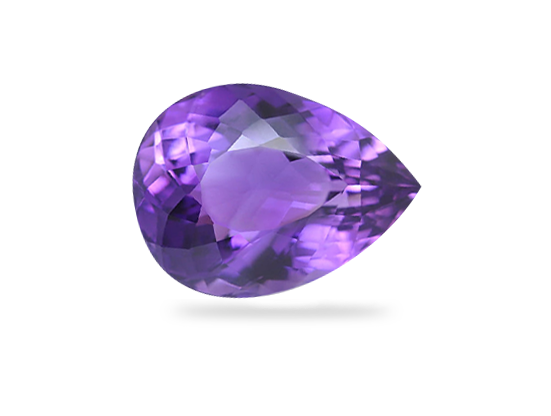
Amethyst is the purple stone of February, loved for thousands of years for its rich violet color. It ranges from soft lilac to deep royal purple, often with flashes of red and blue in the finest stones. It is quartz, so it is durable, easy to care for and one of the most affordable ways to wear a large, vivid colored stone. We set natural amethyst in 925 sterling silver and solid gold at our studio on Sukhumvit 71, Bangkok.
This page covers what amethyst is, how it compares with other purple gems, how to wear and care for it, what makes a good stone, where it comes from, the February birthstone, how to see the stones at our shop, and how to order in Bangkok or anywhere in Thailand.
What amethyst is
Amethyst is the purple variety of quartz, one of the most common minerals on earth. Its color comes from tiny amounts of iron inside the crystal, combined with natural radiation from the surrounding rock over millions of years. Without that, the same quartz would be colorless.
The name comes from the ancient Greek amethystos, which means “not drunk”. The Greeks believed the stone protected its wearer from drunkenness, and they carved drinking cups from it. Later it was a stone of bishops and royalty, and for a long time it was as valuable as ruby and emerald, until large deposits were found in Brazil.
Most amethyst is not treated. Some stones are gently heated to lighten a color that is too dark or to remove a brownish tint, and the result is stable. Strong heat turns amethyst yellow or orange, which is how much of the citrine on the market is made. Every stone we set is natural, amethyst included, and if a stone has had any treatment we tell you before you order.
Amethyst facts at a glance
- Color: pale lilac and lavender to deep violet and royal purple
- Hardness: 7 on the Mohs scale
- Family: quartz, the same mineral as citrine and smoky quartz
- Treatment: usually untreated; some stones are heated to lighten the color
- Best for: rings, pendants, earrings and bracelets, including large statement stones
- Care: warm soapy water and a soft brush; keep out of strong heat and long direct sun
- Price: depends on the quality and carat you choose; we quote before you order
Amethyst and other purple gems
Tanzanite is violet blue and much rarer, and it costs a lot more. It is also softer at 6 to 7 and needs more gentle wear. Amethyst gives a purple color for far less and is tougher.
Iolite is a bluish violet stone at 7 to 7.5 on the Mohs scale. It looks bluer than amethyst and changes color as you turn it.
Purple sapphire is harder at 9 and costs much more. It suits someone who wants purple in a ring that will take very hard wear.
Ametrine is a natural mix of amethyst and citrine in one crystal, purple on one side and golden on the other. It comes mainly from Bolivia.
How to wear and care for amethyst
At 7 on the Mohs scale and with no cleavage, amethyst is a good everyday stone for pendants and earrings, and for rings worn with some care. Dust contains quartz, which is also 7, so over years a ring stone can lose a little of its polish on the facet edges. Take your ring off for the gym, gardening and heavy work.
Clean it in warm soapy water with a soft brush, then rinse and dry. Keep it away from strong heat, which can change its color, and do not leave it for long periods in strong direct sunlight, which can slowly fade some stones. Normal wear in daylight is fine. If it ever needs a polish or a check of the setting, bring it to our shop. Maintenance is free on jewelry we made.
What makes a good amethyst
Color comes first. The most valued amethyst is a deep, rich reddish purple or violet, with flashes of red and blue and no brown or gray. The trade sometimes calls this top color “Siberian”. Lighter lilac stones, sometimes called Rose de France, cost less and are popular for a soft, romantic look.
Even color matters too. Amethyst often grows with color in zones or bands. A stone that looks evenly purple across its face is worth more than one with visible light and dark patches.
Clarity is usually good. Faceted amethyst is normally clean to the eye, so there is no need to accept a stone with visible inclusions.
Cut and size finish the picture. Amethyst is found in large crystals, so big stones are within reach and the price per carat rises only gently with size. A good cut keeps the color bright rather than dark.
Where amethyst comes from
Brazil and Uruguay are the biggest sources, with large geodes lined with purple crystals. Zambia is known for deep, rich stones, and amethyst also comes from Madagascar, Bolivia, Mexico, Namibia and the United States. Russia’s Ural Mountains were a famous historic source, which is where the name “Siberian” comes from. If you want to know the origin of a particular stone, ask us: we offer certified stones, and an uncertified stone can be sent to a gem lab for a report at extra cost.
The February birthstone
Amethyst is the birthstone for February. Its purple color has long stood for calm, clarity and loyalty, which makes it a thoughtful gift for a February birthday, an anniversary or anyone who loves purple. For every month, see our birthstone chart.
See amethyst at our shop in Bangkok
Amethyst often grows with its purple in zones, and an evenly colored stone is worth more than a patchy one, something far easier to check in hand than in a picture. If amethyst brings you in, say so when booking, and stones from pale lilac to deep violet, some larger, will be put aside.
Walk in any time we are open, or book ahead so Yaron is there to help with the stone, the design and the metal, from 925 silver and gold plating to solid 9K, 14K or 18K gold.
Amethyst forms in large crystals, so a big loose stone is a realistic thing to buy on its own. Having jewelry made is optional, and we would be very glad to make something for you.
See amethyst with Yaron
TOANOI House, 259/80 Phibunwet Village, Sukhumvit 71, Bangkok. Monday to Friday 9:30 to 17:00 and Saturday 10:00 to 15:00. We speak Thai, English and Japanese.
Not in Bangkok? Message us and we will send photos and prices of the amethyst we have.
Amethyst questions we get
Is your amethyst natural?
Yes. Every gemstone we set is natural, amethyst included. Most amethyst is untreated, and some stones are gently heated to lighten the color. If a stone has had any treatment we tell you before you order. We are a member of the Thai Gem and Jewelry Traders Association.
Can amethyst fade?
Some amethyst can slowly lighten if it sits in strong direct sunlight or heat for a long time. Normal wear is fine. Store it in a box or pouch when you are not wearing it.
Is amethyst good for an everyday ring?
Yes, with a little care. It is 7 on the Mohs scale and has no cleavage. Take it off for the gym and heavy work, and after some years we can polish it for you.
Do you use lab-grown amethyst?
No. Lab-grown amethyst exists, but we set natural stones only.
How much does amethyst jewelry cost?
It depends on the quality and carat of the stone you choose, and on the metal. We give you the price before anything is made.
Can I buy just the stone?
Yes. Amethyst can be bought unset, and you are under no obligation to order a ring or pendant. If you want it set, today or later on, we are glad to do it.
How long does an amethyst piece take?
7 to 10 working days from your order, because the stones are already here in our shop, then 1 to 3 working days for delivery inside Thailand. We also ship abroad by FedEx.
Every amethyst piece is made to order by our team in Bangkok in 925 sterling silver or solid gold, with a 3-year warranty, free maintenance and free shipping across Thailand.
