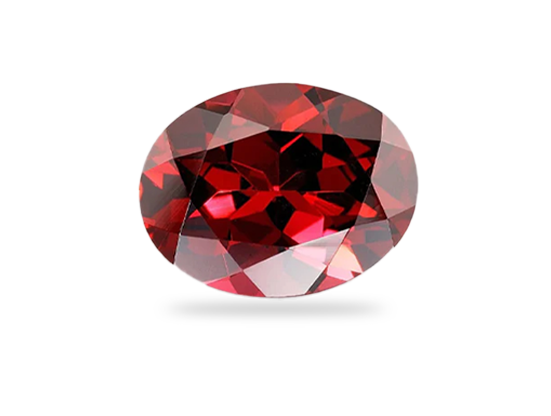
Garnet is the deep red stone of January, warm as red wine and tough enough for a ring you wear every day. Most people know it as a dark red gem, but garnet is really a whole family of minerals, with members in raspberry pink, bright orange and vivid green. The classic red garnets are almandine and pyrope, and they give some of the best value for money among red gems. We set natural garnet in 925 sterling silver and solid gold at our studio on Sukhumvit 71, Bangkok.
This page covers what garnet is, the main members of the garnet family, how it compares with other red gems, how to wear and care for it, what makes a good stone, where it comes from, the January birthstone, how to see the stones at our shop, and how to order in Bangkok or anywhere in Thailand.
What garnet is
Garnet is not one mineral but a group of closely related silicates that share the same crystal structure. They differ in the metals inside them, and that is what gives each type its color. The name comes from the Latin granatum, pomegranate, because small red garnet crystals look like the seeds of the fruit.
The classic red garnets are almandine, an iron aluminum garnet, and pyrope, a magnesium aluminum garnet. Almandine tends toward a deep red with a hint of purple or brown. Pyrope is often a purer, blood red, and was the famous Bohemian garnet worn across Europe in the nineteenth century. Many red stones in the trade are a natural mix of the two.
Garnet is one of the few gem families that is almost never treated. Its color is natural and stable, so it will not fade. Every stone we set is natural, garnet included, and if a stone has had any treatment we tell you before you order.
Garnet facts at a glance
- Color: deep red, wine red and brownish red; the family also comes in pink, orange and green
- Hardness: 6.5 to 7.5 on the Mohs scale, depending on the type
- Family: almandine, pyrope, rhodolite, spessartite, tsavorite and more
- Treatment: almost never treated
- Best for: rings, pendants, earrings and bracelets
- Care: warm soapy water and a soft brush
- Price: depends on the quality and carat you choose; we quote before you order
The garnet family
Beyond the classic dark reds, three garnets are popular enough that we give them their own pages.
Rhodolite is a natural blend of pyrope and almandine with a lighter, brighter color, from pinkish red to raspberry and purplish red. It is the garnet for people who find the classic red too dark.
Spessartite is the orange garnet, colored by manganese. The brightest stones, called Mandarin garnet, glow like a ripe orange.
Tsavorite is the green garnet from East Africa, a grossular garnet colored by vanadium and chromium. A fine tsavorite can rival emerald for color and is harder and more durable.
There are other members too, such as the rare green demantoid, but these are the ones most people ask us about.
Garnet and other red gems
Ruby is red corundum, 9 on the Mohs scale, and costs far more. Garnet has a darker, warmer red, while ruby is brighter and often has a pinkish glow.
Rubellite is red to pink tourmaline. It is often lighter and pinker than garnet and usually costs more for a clean stone.
Red spinel is harder at 8 and very bright, but fine red spinel is rare and much more expensive. For a deep red stone at a friendly price, garnet is hard to beat.
How to wear and care for garnet
Almandine and pyrope sit around 7 to 7.5 on the Mohs scale, which is fine for rings, pendants and earrings worn every day. Garnet has no cleavage, so it does not split easily, but a hard knock on an edge can still chip it. Take your ring off for the gym, gardening and heavy work to protect both the stone and the setting.
Clean it in warm soapy water with a soft brush, then rinse and dry. Avoid sudden changes of temperature, such as hot water straight after the cold. Store it apart from diamonds and sapphires, which can scratch it. If it ever needs a polish or a check of the setting, bring it to our shop. Maintenance is free on jewelry we made.
What makes a good garnet
Color comes first. The best red garnets have a rich, pure red that is not too dark. Some almandine looks almost black in low light, so a stone with life and a little brightness is worth more than one that only looks dark.
Clarity is usually good. Red garnets are often clean to the eye, so you can expect a stone without visible inclusions.
Cut matters a lot for dark stones. A good cut, and sometimes a shallower one, lets light back out so the color glows instead of going black.
Size is less of a limit than with most gems. Red garnet is found in large crystals, so bigger stones stay affordable, and the price rises gently with carat.
Where garnet comes from
Garnet is found on every continent. Red almandine and pyrope come from India, Sri Lanka, Madagascar, Mozambique, Tanzania, Brazil and the United States, and the old Bohemian pyrope from the Czech Republic. Thailand also has a long garnet history: the gem markets of Chanthaburi have traded and cut garnet for generations. If you want to know the origin of a particular stone, ask us: we offer certified stones, and an uncertified stone can be sent to a gem lab for a report at extra cost.
The January birthstone
Garnet is the birthstone for January, a warm red for the coldest month of the year in much of the world. The January birthstone is the classic red garnet. Rhodolite, spessartite and tsavorite belong to the same family, but they are not January birthstones; they are lovely stones in their own right. For every month, see our birthstone chart.
See garnet at our shop in Bangkok
Some red garnet looks almost black in low light, while a well cut stone glows like red wine, and only real light shows which is which. Mention garnet as you book, and several stones in deeper and brighter reds, in a few sizes, will be waiting so you can pick one with life in it.
Walk in any time we are open, or book ahead so Yaron is there to help with the stone, the design and the metal, from 925 silver and gold plating to solid 9K, 14K or 18K gold.
Garnet is almost never treated and its color will not fade, so a loose garnet keeps well until you decide. You do not have to have jewelry made, but we would be very happy to make a piece for you.
See garnet with Yaron
TOANOI House, 259/80 Phibunwet Village, Sukhumvit 71, Bangkok. Monday to Friday 9:30 to 17:00 and Saturday 10:00 to 15:00. We speak Thai, English and Japanese.
Not in Bangkok? Message us and we will send photos and prices of the garnet we have.
Garnet questions we get
Is your garnet natural?
Yes. Every gemstone we set is natural, garnet included, and garnet is almost never treated. If a stone has had any treatment we tell you before you order. We are a member of the Thai Gem and Jewelry Traders Association.
Is garnet only red?
No. Red is the best known color, but the garnet family also includes pink rhodolite, orange spessartite and green tsavorite. The only color garnet almost never comes in is blue.
Can I wear a garnet ring every day?
Yes. Red garnet is around 7 to 7.5 on the Mohs scale and has no cleavage, so it handles daily wear well. Take it off for the gym and heavy work, and clean it now and then in soapy water.
What is the difference between garnet and ruby?
They are different minerals. Ruby is corundum, harder at 9 on the Mohs scale and much more expensive. Garnet is usually a darker, warmer red and gives a lot of color for the money.
How much does garnet jewelry cost?
It depends on the quality and carat of the stone you choose, and on the metal. We give you the price before anything is made.
Can I buy just the stone?
Yes. We sell garnet unset, with no need to commission a ring or pendant. Whenever you want it mounted, today or months from now, we will happily take care of the setting.
How long does a garnet piece take?
7 to 10 working days from your order, because the stones are already here in our shop, then 1 to 3 working days for delivery inside Thailand. We also ship abroad by FedEx.
Every garnet piece is made to order by our team in Bangkok in 925 sterling silver or solid gold, with a 3-year warranty, free maintenance and free shipping across Thailand.
