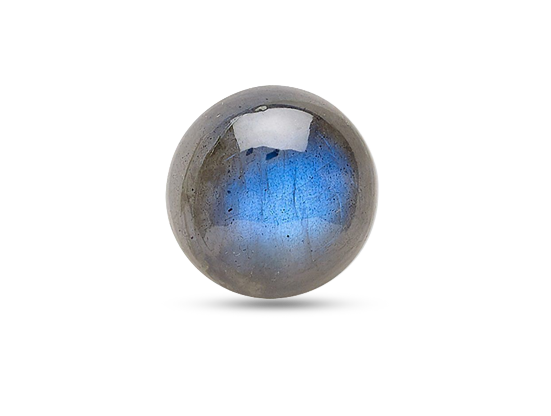
Labradorite looks like a quiet gray stone until you turn it, and then a flash of electric blue, green, gold or even orange sweeps across its face. That play of color, called labradorescence, makes every stone one of a kind. It is a natural feldspar, a close relative of moonstone, and a striking choice for a pendant or a pair of earrings. We set natural labradorite in 925 sterling silver and solid gold at our studio on Sukhumvit 71, Bangkok.
This page covers what labradorite is, where its flash comes from, rainbow moonstone, how it compares with other stones with a glow, how to wear and care for it, what makes a good stone, how to see the stones at our shop, and how to order in Bangkok or anywhere in Thailand.
What labradorite is
Labradorite is a plagioclase feldspar, a mineral of the same large family as moonstone. It was named after the Labrador coast of Canada, where it was described in the late eighteenth century. Its body color is usually gray to dark gray, sometimes almost black, and sometimes nearly colorless.
The flash is not a pigment. Inside the crystal are extremely thin layers that formed as it cooled. Light bounces between those layers and interferes with itself, the same way color appears on a soap bubble, so you see a vivid blue or green that seems to float under the surface. The color only appears at certain angles, which is why the stone seems to switch on and off as you move.
Labradorite is almost never treated. Every stone we set is natural, labradorite included, and if a stone has had any treatment we tell you before you order.
Labradorite facts at a glance
- Family: plagioclase feldspar, related to moonstone
- Color: gray to dark gray body with flashes of blue, green, gold, orange and sometimes violet
- Hardness: 6 to 6.5 on the Mohs scale
- Treatment: almost never treated
- Best for: pendants, earrings and bracelets; rings with care
- Care: warm soapy water and a soft cloth; no ultrasonic or steam cleaners
- Price: depends on the quality and carat you choose; we quote before you order
Rainbow moonstone and spectrolite
Rainbow moonstone is a trade name for a pale, almost colorless labradorite with a blue and rainbow flash. Gemologically it is labradorite rather than true moonstone, but the name is so common that most buyers know it this way. It is a natural stone and a lovely one, and we always tell you which stone you are buying.
Spectrolite is a name used for labradorite from Finland with an especially dark body and a full spectrum of flash colors. You may see the name used for other very colorful labradorite as well.
Labradorite and other stones with a glow
Moonstone shows a soft, milky blue or white glow that floats over a pale stone. Labradorite is bolder and darker, with stronger colors that switch on as the stone moves.
Opal shows patches of many colors at once from almost every angle. Labradorite usually shows one or two strong colors in broad sweeps, and it is a little harder than opal.
Black spinel is a sparkling faceted dark stone. If you like dark stones but want color and movement rather than sparkle, labradorite is the one.
How to wear and care for labradorite
At 6 to 6.5 on the Mohs scale, labradorite is softer than quartz, and like all feldspars it has cleavage, so a hard knock can split it. That makes it ideal for pendants, earrings and bracelets. A labradorite ring is a beautiful statement piece; a protective bezel setting helps, and take it off for the gym, cleaning and gardening.
Clean it in warm soapy water with a soft cloth, then rinse and dry. Keep it away from ultrasonic and steam cleaners, sudden heat and strong chemicals. If it ever needs a polish or a check of the setting, bring it to our shop. Maintenance is free on jewelry we made.
What makes a good labradorite
Flash matters most. Look for strong, bright color that covers much of the face of the stone. Blue is the classic, and stones that show several colors, such as blue with gold, orange or violet, are especially prized.
Orientation decides where you see it. A well cut labradorite shows its flash when you look straight down at it, not only from the side.
Body color and clarity set the mood. Darker stones make the flash look more dramatic. Fine dark needles and lines inside are normal and give each stone its character.
Cut is usually a smooth dome, called a cabochon, which shows the flash best. Pale rainbow moonstone is also sometimes faceted for sparkle.
Where labradorite comes from
Labradorite is found in Canada, where it was first named, in Finland, home of spectrolite, and in Madagascar, which supplies much of the colorful material on the market today. It also comes from India, the source of most rainbow moonstone, and from Norway, Russia and the United States. If you want to know the origin of a particular stone, ask us: we offer certified stones, and an uncertified stone can be sent to a gem lab for a report at extra cost.
See labradorite at our shop in Bangkok
Until it catches the light at the right angle, labradorite looks like a quiet gray stone, and then a sweep of blue, green or gold switches on, different in every piece. If you tell us ahead that labradorite is the stone, we will have several ready with different flash colors, on both dark and pale bodies.
Walk in any time we are open, or book ahead so Yaron is there to help with the stone, the design and the metal, from 925 silver and gold plating to solid 9K, 14K or 18K gold.
Every labradorite flashes in its own way, so you may want to keep yours just as it is. Loose stones are for sale with no jewelry order needed, and we would be very happy to build a piece around it.
See labradorite with Yaron
TOANOI House, 259/80 Phibunwet Village, Sukhumvit 71, Bangkok. Monday to Friday 9:30 to 17:00 and Saturday 10:00 to 15:00. We speak Thai, English and Japanese.
Not in Bangkok? Message us and we will send photos and prices of the labradorite we have.
Labradorite questions we get
Is your labradorite natural?
Yes. Every gemstone we set is natural, labradorite included, and labradorite is almost never treated. We are a member of the Thai Gem and Jewelry Traders Association.
Why does labradorite change color?
Very thin layers inside the crystal reflect light and make it interfere, like color on a soap bubble. The color appears only at certain angles, so it flashes on and off as you move the stone.
Is rainbow moonstone the same as labradorite?
Yes, in gemology rainbow moonstone is a pale labradorite with a rainbow flash. It is a natural stone, and we always tell you which stone you are buying.
Can I wear a labradorite ring every day?
With care. Labradorite is 6 to 6.5 on the Mohs scale and can split from a hard knock, so take the ring off for the gym, cleaning and gardening. Pendants and earrings are the easiest way to wear it daily.
How much does labradorite jewelry cost?
It depends on the quality and carat of the stone you choose, and on the metal. We give you the price before anything is made.
Can I buy just the stone?
Yes. A labradorite can be bought by itself, without a setting. If you want it made into a pendant or earrings, now or later, we are happy to set it, and for a ring a protective bezel helps.
How long does a labradorite piece take?
7 to 10 working days from your order, because the stones are already here in our shop, then 1 to 3 working days for delivery inside Thailand. We also ship abroad by FedEx.
Every labradorite piece is made to order by our team in Bangkok in 925 sterling silver or solid gold, with a 3-year warranty, free maintenance and free shipping across Thailand.
Photo: Mauro Cateb, CC BY-SA 4.0, cropped.
