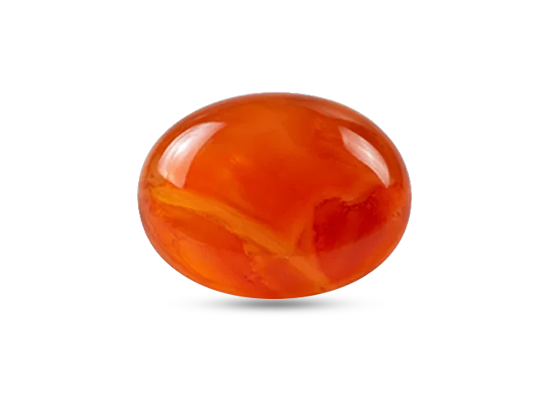
Carnelian is the warm orange red of a sunset seen through amber glass, a translucent stone that seems to hold a small light inside. People have carved it and worn it for thousands of years. It is a natural chalcedony, part of the quartz family, and tough enough for a ring you wear every day. In ancient Rome, carnelian signet rings were pressed into wax to seal letters, and it still makes a handsome seal ring, pendant or string of beads. We set natural carnelian in 925 sterling silver and solid gold at our studio on Sukhumvit 71, Bangkok.
This page covers what carnelian is, where its color comes from, how it differs from sard and dyed agate, how it compares with other orange and red stones, how to wear and care for it, what makes a good stone, how to see the stones at our shop, and how to order in Bangkok or anywhere in Thailand.
What carnelian is
Carnelian is a chalcedony, a form of quartz made of crystals so fine that you cannot pick them out even under an ordinary microscope. It belongs to the same mineral family as amethyst and citrine, and it is a close cousin of onyx, which is chalcedony too. Amethyst grows as one large clear crystal; carnelian is a dense mass of tiny ones, so it is translucent rather than transparent and has a soft, waxy glow.
The color comes from small amounts of iron oxide spread through the stone. More iron gives a deeper red, less gives orange or a pale apricot. Hold a good carnelian up to a window and the light comes through it like a warm lamp, usually with a slightly cloudy, uneven glow. That cloudiness is typical of the natural stone.
Carnelian is often heated, and this is a very old practice. Bead makers in the Indus Valley were warming the stone to deepen its red more than four thousand years ago. Heat turns brownish and yellowish iron oxides red, and the new color is stable. Much of what is sold as carnelian today is gray or pale agate from Brazil or Uruguay that has been heated or dyed orange. Every carnelian we set is natural chalcedony, and if a stone has been heated or dyed we always tell you before you order.
Carnelian facts at a glance
- Family: chalcedony (microcrystalline quartz), related to agate and onyx
- Color: orange, red orange and deep red, from pale apricot to brownish red
- Hardness: 6.5 to 7 on the Mohs scale
- Treatment: often heated to deepen the color; some stones on the market are dyed agate
- Best for: rings, signet rings, pendants, earrings, bracelets and beads
- Care: warm soapy water and a soft cloth; keep away from strong chemicals
- Price: depends on the quality and carat you choose; we quote before you order
Carnelian, sard and dyed agate
Sard is the name for the darker, browner end of the same stone. There is no sharp line between the two: an orange to red stone is carnelian, a chestnut to brownish red one is sard, and plenty of stones sit in between. When red and white layers alternate in one stone it is called sardonyx, a favorite for carved cameos since Roman times.
Dyed agate is the one to watch for. Agate is banded chalcedony, and its layers soak up dye unevenly, so a dyed piece often shows strong stripes of color, a flat and very even saturation, or color sitting in small cracks. Natural carnelian usually looks cloudy rather than striped, with soft patches of deeper and lighter color. Not every banded stone is dyed and not every even stone is natural, which is why we tell you exactly what each stone is.
Carnelian and other orange and red stones
Citrine is a transparent orange to yellow quartz, cut with facets so it sparkles. Carnelian is from the same family but translucent, with a glow rather than a sparkle.
Spessartite is a bright orange garnet with real fire when it is faceted. It suits a modern ring with sparkle; carnelian suits a smooth dome, a seal ring or beads.
Garnet in its classic deep red is darker and usually faceted. If you love red stones but want something warmer and lighter, carnelian is the easygoing choice.
How to wear and care for carnelian
At 6.5 to 7 on the Mohs scale, with no cleavage and a tight, tough structure, carnelian is one of the easiest stones to live with. It is a good choice for a ring you never take off, which is exactly why seal rings were made from it. A carved or engraved face can still pick up fine scratches over the years from grit that is harder than quartz, so take the ring off for the gym, heavy cleaning and gardening if you want the edges to stay crisp.
Clean it in warm soapy water with a soft cloth, then rinse and dry. Keep it away from strong chemicals and bleach. An ultrasonic cleaner is usually fine for natural carnelian but not for dyed stones, so ask us if you are not sure. Strong sun will not fade natural carnelian, while dyed stones can lose color, one more reason to know what you are buying. If it ever needs a polish or a check of the setting, bring it to our shop. Maintenance is free on jewelry we made.
What makes a good carnelian
Color comes first. Look for an even, saturated orange red that glows when light passes through. A deep red orange is the classic, and a clear bright orange is lovely too. Dull brownish or muddy stones are worth less.
Translucency is what gives carnelian its life. The best stones let light through like honey or strong tea, so they seem lit from inside. Very opaque stones look flat.
Clarity and pattern tell you a lot. Soft clouds and gentle shifts in color are normal and are a sign of a natural stone. Cracks, pits and sharp stripes that look dyed lower the value.
Cut is usually a cabochon, a smooth dome, or beads, flat tablets for seal rings, and carvings. Faceted carnelian exists too and gives a soft, glowing sparkle.
Where carnelian comes from
Carnelian has been mined in India for thousands of years, and the bead workshops of Khambhat in Gujarat are still known for it. Today it also comes from Brazil and Uruguay, where large amounts of agate and carnelian are found, and from Madagascar and Indonesia. If you want to know the origin of a particular stone, ask us: we offer certified stones, and an uncertified stone can be sent to a gem lab for a report at extra cost.
See carnelian at our shop in Bangkok
Carnelian is a stone to see against your own skin. On a screen it can look like plain orange, but in daylight at the shop it starts to glow, and the difference between a bright orange and a deep blood red becomes easy to feel. If you tell us ahead that carnelian is the stone, we will have several ready, from apricot to deep red, in different shapes and sizes.
Walk in any time we are open, or book ahead so Yaron is there to help with the stone, the design and the metal, from 925 silver and gold plating to solid 9K, 14K or 18K gold.
A good carnelian is also a nice thing to carry in your pocket or give as a small gift, so you can buy a loose stone with no jewelry order needed. If you decide later that you want it set, we will happily make the piece around it.
See carnelian with Yaron
TOANOI House, 259/80 Phibunwet Village, Sukhumvit 71, Bangkok. Monday to Friday 9:30 to 17:00 and Saturday 10:00 to 15:00. We speak Thai, English and Japanese.
Not in Bangkok? Message us and we will send photos and prices of the carnelian we have.
Carnelian questions we get
Is your carnelian natural?
Yes. Every carnelian we set is natural chalcedony. Carnelian is often heated to deepen its color, a practice thousands of years old, and some stones on the market are dyed agate. If a stone has been heated or dyed, we tell you before you order. We are a member of the Thai Gem and Jewelry Traders Association.
What is the difference between carnelian and sard?
They are the same stone at two ends of one color range. Orange to red is called carnelian, and the darker brownish red is called sard. Many stones sit in between.
How can I tell carnelian from dyed agate?
Dyed agate often shows strong stripes of color or color sitting in cracks, while natural carnelian usually has a soft, cloudy glow. It is not always easy to see by eye, so we tell you exactly what each stone is.
Can I wear a carnelian ring every day?
Yes. Carnelian is 6.5 to 7 on the Mohs scale and tough, which is why it was used for seal rings for centuries. Take it off for the gym and heavy work if you want an engraved face to stay sharp.
How much does carnelian jewelry cost?
It depends on the quality and carat of the stone you choose, and on the metal. We give you the price before anything is made.
Can I buy just the stone?
Yes. You can buy a carnelian by itself, with no setting and no jewelry order. If you want it made into a ring, pendant or earrings, now or later, we are happy to set it.
How long does a carnelian piece take?
7 to 10 working days from your order, because the stones are already here in our shop, then 1 to 3 working days for delivery inside Thailand. We also ship abroad by FedEx.
Every carnelian piece is made to order by our team in Bangkok in 925 sterling silver or solid gold, with a 3-year warranty, free maintenance and free shipping across Thailand.
