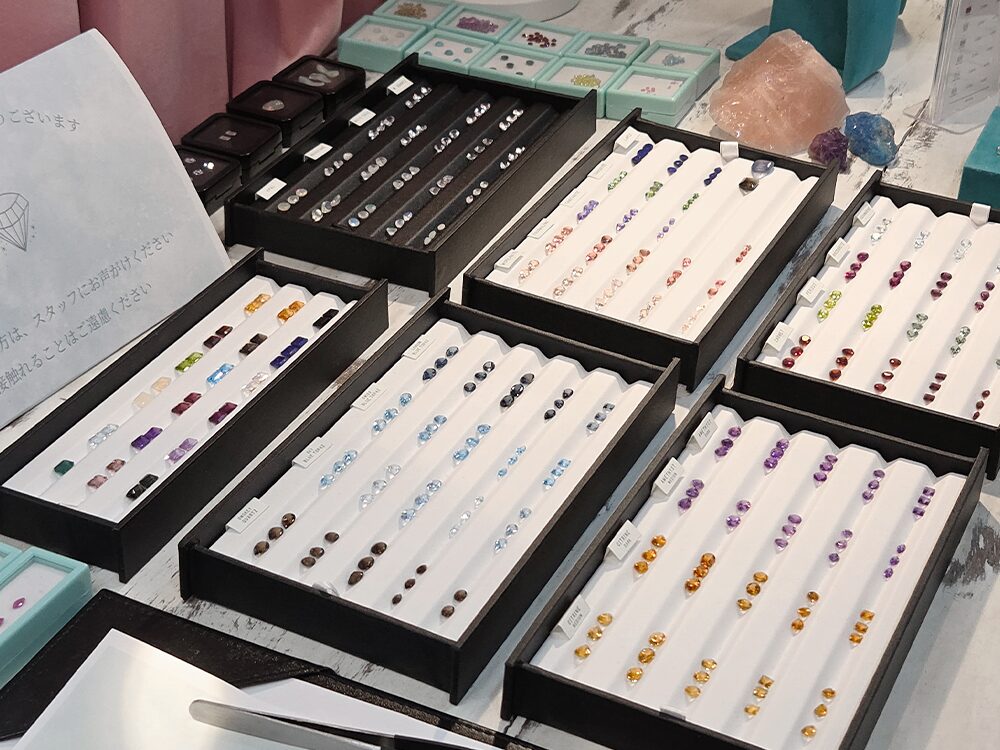
Bangkok has traded gemstones for a very long time, and it is still one of the best places in the world to see sapphire, ruby and a hundred other stones side by side. If you are buying a loose stone or a piece of jewelry here, a few plain questions will tell you exactly what you are getting. These are the questions we would ask any jeweler, ourselves included.
We make made-to-order jewelry with natural gemstones at our studio on Sukhumvit 71, so we hear these questions every week. Below is what to ask, why it matters, and what a good answer sounds like.
1. Is the stone natural?
Start here. A natural gemstone formed in the ground. A lab-grown stone has the same chemistry but was made in a factory, and an imitation is a different material that only looks similar, such as glass. All three are sold legally and all three have their place, but they are priced very differently, so the seller should tell you which one it is, and write it on your receipt.
A good answer is short and specific: “natural blue sapphire”, not “real stone” or “gemstone quality”.
2. Has it been treated, and how?
Many natural gemstones are treated after mining to improve their color or clarity, and that is normal. Heating sapphire and ruby is the most common example. It is a long-accepted practice, the result is stable, and a heated sapphire is still a natural sapphire.
Other treatments exist too, and some of them change how you should clean the stone or what it is worth. So ask the simple version: “Is this stone treated, and which treatment?” Then ask for the answer on the receipt. An unheated sapphire costs noticeably more than a heated one of the same look, which is exactly why it helps to have it in writing.
3. Is there a lab report?
For a larger or more expensive stone, a report from an independent gem laboratory confirms what the stone is, its weight, and any treatment. Bangkok has its own national lab, the Gem and Jewelry Institute of Thailand (GIT), and several international labs have offices in the city as well.
For the small stones you find in everyday jewelry, a report often costs more than the stone itself, so most pieces are sold without one. That is fine. Ask whether a report comes with the stone, and if not, whether one could be arranged if you want it. For a stone you are buying as an investment or a centerpiece, a report is worth having.
4. Is the shop a member of a trade association?
The Thai Gem and Jewelry Traders Association (TGJTA) represents the Thai gem and jewelry trade, and its members are listed in a public member search on its website. Membership tells you the business is part of the established trade here. Colors by Love is a member, under our company name TOANOI.
5. What exactly goes on the receipt?
A clear receipt names the stone, says natural or not, notes any treatment, and gives the weight or size. If the stone is set in jewelry, it should also name the metal: 925 sterling silver, or solid gold with the karat (9K, 14K or 18K). Gold plating over silver is a perfectly good choice for everyday jewelry, but it should be described as plated.
6. What happens after you buy?
Ask about the warranty, about resizing a ring later, and what happens if a stone comes loose. Jewelry made in Bangkok is easy to service if the maker is in Bangkok too. Ours comes with a 3-year warranty and free maintenance at our shop.
Where to start looking
If you want to see natural stones before you commit, our gemstones page shows the birthstone for every month and the range we keep in the trays. For a sapphire specifically, read sapphire jewelry in Bangkok. If you have your own design in mind, our custom jewelry in Bangkok page explains how we make a piece from a photo or a sketch.
Ask us the same questions
Every stone we set is natural, we tell you before you order if a stone has been treated, and we set them by hand at TOANOI House, 259/80 Phibunwet Village, Sukhumvit 71, Bangkok. We are open Monday to Friday 9:30 to 17:00 and Saturday 10:00 to 15:00. Come and look at the stones in daylight, or message us first.
Questions about buying gemstones in Bangkok
Is Bangkok a good place to buy gemstones?
Yes. Thailand has been a center of the colored gemstone trade for generations, with cutting, trading and setting all done here, so the choice is wide and you can see stones in person before you buy.
What is the difference between a natural and a lab-grown sapphire?
A natural sapphire formed in the earth. A lab-grown sapphire has the same chemistry and hardness but was made in a laboratory. They can look very similar, so the seller’s description and, for a valuable stone, a lab report are how you tell them apart. They are priced very differently.
Is a heated sapphire still natural?
Yes. Heating is a common and accepted treatment for natural sapphire and ruby, and the stone is still natural. It should be disclosed, and unheated stones of similar quality cost more.
Do I need a lab report for a small stone?
Usually not. For small stones in everyday jewelry a report can cost more than the stone. For a large or expensive stone, ask for one or ask whether it can be arranged.
What is the TGJTA?
The Thai Gem and Jewelry Traders Association, the trade association for gem and jewelry businesses in Thailand. You can check whether a business is a member on its website.
