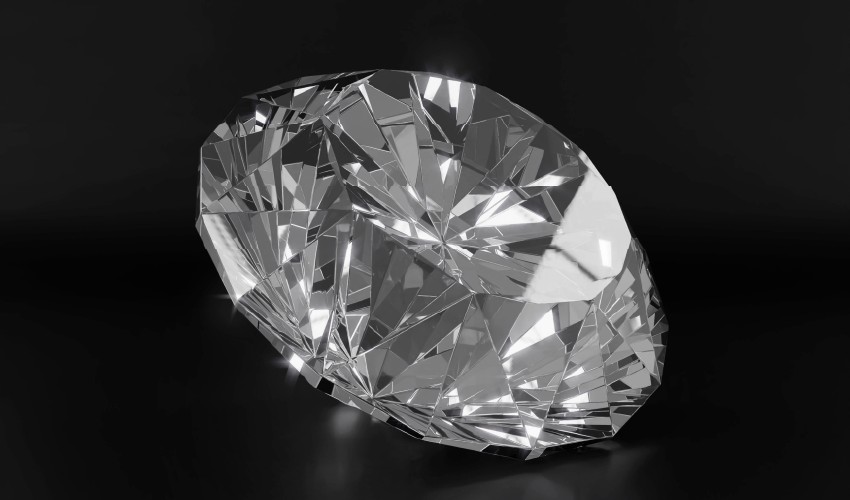
Diamond is the hardest natural material on earth, the April birthstone and the classic stone for an engagement ring. Its sparkle comes from a rare mix of brilliance and fire that no other white stone quite matches. Choosing one is easier than it looks once you know the four things that set its value. We set natural diamond in 925 sterling silver and solid gold at our studio on Sukhumvit 71, Bangkok.
This page covers what diamond is, the 4Cs, how diamond compares with other white stones, how to wear and care for it, what makes a good diamond, where diamonds come from, how to see the stones at our shop, and how to order in Bangkok or anywhere in Thailand.
What diamond is
Diamond is pure carbon, crystallized deep inside the earth under enormous heat and pressure, then carried to the surface by volcanic rock. Most diamonds are billions of years old.
At 10 on the Mohs scale diamond is the hardest of all minerals. Nothing in daily life will scratch it. It is not unbreakable, though: diamond has cleavage, so a hard knock at the wrong angle can chip it. A good setting protects the edges.
The ideal diamond is colorless. Small amounts of nitrogen give a faint yellow tint, and rare stones show strong colors such as yellow, pink or blue, called fancy colors. Diamond bends light strongly and splits it into flashes of color, which gives the white sparkle and the rainbow fire it is famous for.
Some diamonds are treated, for example laser drilled to remove a dark inclusion, fracture filled to hide a crack, or processed to change their color. Our focus is natural diamond. If a natural diamond has had any treatment, we tell you before you order. A lab report states any treatment clearly.
Diamond facts at a glance
- Color: colorless to faint yellow or brown; rare fancy colors
- Mineral: crystallized carbon
- Hardness: 10 on the Mohs scale
- Treatment: most diamonds are untreated; any treatment is disclosed before you order
- Best for: engagement rings, wedding bands, studs, pendants and everyday rings
- Care: warm soapy water and a soft brush; diamonds attract grease, so clean often
- Price: depends on the quality and carat you choose; we quote before you order
The 4Cs
Diamonds are graded on four qualities, called the 4Cs. Every certificate lists them.
Cut is how well the stone is shaped and polished. It is the C that controls sparkle. A well cut diamond returns light up through the top; a badly cut one looks glassy or dark in the center even if its other grades are high. For round brilliants, labs grade cut from Excellent down to Poor.
Color is graded on a letter scale from D, which is fully colorless, down to Z, which is light yellow. D to F are colorless, G to J are near colorless and look white once set, and from K down a warm tint starts to show. Yellow gold hides a little warmth, white metal shows it more.
Clarity describes inclusions and surface marks under 10x magnification, from Flawless through VVS and VS to SI and I. Most people cannot see anything inside a VS stone with the naked eye, and many SI stones look clean too.
Carat is weight, not size. One carat is 0.2 grams. Price rises much faster than weight, so a one carat diamond costs far more than two half carat stones of the same quality.
Diamond and other white stones
White sapphire is colorless corundum, 9 on the Mohs scale. It is very durable and costs much less, but it has less fire and looks softer and calmer than a diamond.
White topaz is 8 on the Mohs scale and the most affordable natural white stone we set. It is bright when clean, but it loses its polish sooner and does not have diamond’s fire.
Zircon is a natural stone with strong fire, sometimes close to diamond. It is softer and its facet edges wear in a daily ring, so it suits earrings and pendants better.
Lab-grown diamond is real diamond, the same carbon crystal with the same hardness and sparkle, grown in a laboratory instead of mined. It costs much less than a natural diamond of the same size. Our focus is natural diamond, but we can offer lab-grown too, always clearly labeled so you know exactly what you are buying.
How to wear and care for diamond
Diamond is made for everyday wear. It suits engagement rings, wedding bands and studs you sleep in. Because it can chip from a hard blow, take rings off for the gym, sport and heavy work, and have the claws checked now and then so a stone never comes loose.
Diamonds love grease. Hand cream, soap and skin oil make them look dull, so clean them often in warm soapy water with a soft brush, especially under the stone, then rinse and dry. Store diamond jewelry apart from other pieces, because it will scratch every other gem and even gold. If it ever needs a polish or a check of the setting, bring it to our shop. Maintenance is free on jewelry we made.
What makes a good diamond
Cut comes first. Spend on cut before anything else, because a well cut G or H with small inclusions will outshine a poorly cut stone with top grades.
Color should look white in its setting. G to I is the sweet spot for most people, especially in white metal. In yellow or rose gold a slightly warmer grade looks just as bright.
Clarity only has to be clean to the eye. VS2 and SI1 stones that look clean face up give the most beauty for the money.
Carat is where budgets meet. Stones just under a round weight, such as 0.9 instead of 1 carat, look the same size and cost noticeably less.
The certificate confirms everything. For larger diamonds a report from a respected lab such as GIA lists the 4Cs, measurements and any treatment.
Where diamond comes from
Most natural diamonds today come from Botswana, Russia, Canada, Australia, South Africa, Angola, Namibia and the Democratic Republic of the Congo. India was the world’s only known source for many centuries, and it is now the largest cutting center. Diamonds then move through trading hubs such as Antwerp, Dubai and Mumbai on their way to jewelers.
If you want to know the origin of a particular stone, ask us: we offer certified stones, and an uncertified stone can be sent to a gem lab for a report at extra cost.
The April birthstone
Diamond is the birthstone for April and the traditional gem for a sixtieth wedding anniversary. A small diamond makes a lovely birthday gift or a stone in a family ring where each person gets their own month. Our birthstone chart shows all twelve months if you are building a ring or bracelet for the whole family.
See diamond at our shop in Bangkok
Cut controls the sparkle, and color reads differently by metal, since yellow gold hides a little warmth and white metal shows more. Both are easier to judge in your hand. Book with diamond as your stone and we will prepare more natural diamonds in several color grades and carat weights for you to compare side by side.
Walk in any time we are open, or book ahead so Yaron is there to help with the stone, the design and the metal, from 925 silver and gold plating to solid 9K, 14K or 18K gold.
Some people like to choose a diamond by its grades and certificate before the ring is designed. You can buy one loose with no jewelry order, and we would be very happy to make a piece for you.
See diamond with Yaron
TOANOI House, 259/80 Phibunwet Village, Sukhumvit 71, Bangkok. Monday to Friday 9:30 to 17:00 and Saturday 10:00 to 15:00. We speak Thai, English and Japanese.
Not in Bangkok? Message us and we will send photos and prices of the diamond we have.
Diamond questions we get
Is your diamond natural?
Yes. Natural, mined diamonds are our focus, and most are untreated. Lab-grown is available if you ask for it, always clearly labeled. If a stone has had any treatment, such as laser drilling or fracture filling, we tell you before you order. We are a member of the Thai Gem and Jewelry Traders Association.
Do you sell lab-grown diamonds?
Yes, if you ask for it. Our focus is natural diamond, but we can offer lab-grown as well, and we always tell you clearly which one is which before you order.
What are the 4Cs?
Cut, color, clarity and carat, the four grades that set a diamond’s value. Cut controls the sparkle, color runs from D colorless to Z light yellow, clarity describes inclusions, and carat is the weight.
Does my diamond come with a certificate?
We offer certified diamonds, and larger stones are best bought with a lab report. An uncertified stone can be sent to a gem lab for a report at extra cost.
Can a diamond break?
It is the hardest material on earth, so it will not scratch, but a hard knock at the wrong angle can chip it. A good setting protects the edges, so take rings off for sport and heavy work.
How much does diamond jewelry cost?
It depends on the quality and carat of the stone you choose, and on the metal. We give you the price before anything is made.
Can I buy just the stone?
Yes. A loose natural diamond can be bought without any jewelry order, and lab-grown is available too. If you want it in an engagement ring, band or studs, set right away or later, we are happy to do it.
How long does a diamond piece take?
7 to 10 working days from your order, because the stones are already here in our shop, then 1 to 3 working days for delivery inside Thailand. We also ship abroad by FedEx.
Every diamond piece is made to order by our team in Bangkok in 925 sterling silver or solid gold, with a 3-year warranty, free maintenance and free shipping across Thailand.
