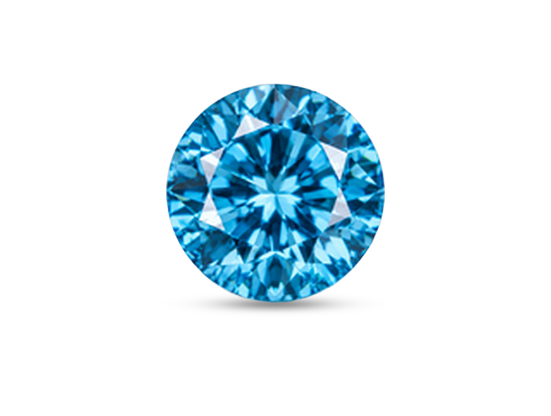
Zircon is one of the most brilliant natural gems there is, and one of the most misunderstood. Many people hear the name and think of cubic zirconia, the lab-made diamond copy. Real zircon is something else entirely: a natural mineral, older than almost anything else on Earth, with a sparkle and fire close to diamond. Blue zircon is a bright, electric sky blue, and white zircon is a crisp, colorless stone full of flashes. We set natural zircon in 925 sterling silver and solid gold at our studio on Sukhumvit 71, Bangkok.
This page covers what zircon is, why it is not cubic zirconia, blue and white zircon and how they get their color, how it compares with other stones, how to wear and care for it, what makes a good stone, where it comes from, how to see the stones at our shop, and how to order in Bangkok or anywhere in Thailand.
What zircon is
Zircon is a zirconium silicate, a mineral found all over the world in small grains and, more rarely, in crystals large enough to cut. Some zircon grains from Western Australia are more than four billion years old, the oldest known pieces of the Earth’s crust. Gem zircon comes in many natural colors, including brown, red, orange, yellow and green.
What makes zircon special is the way it handles light. It bends light very strongly, which gives it a bright, glassy brilliance, and it splits white light into colors almost as well as diamond does, so a well cut zircon throws small flashes of rainbow fire. It is also strongly doubly refractive: look into a zircon with a loupe and the back facets appear doubled, a quick way gemologists tell it apart from diamond.
In Thai, zircon is called phethai, one of the nine gems of the traditional Thai nopphakao set.
Zircon facts at a glance
- Family: zircon, a natural zirconium silicate (not cubic zirconia)
- Color: blue and colorless in this article; also brown, red, orange, yellow and green
- Hardness: 6.5 to 7.5 on the Mohs scale, with facet edges that can chip
- Treatment: blue is almost always heated; colorless is usually heated too; we tell you before you order
- Best for: pendants and earrings; rings in a protective setting
- Care: warm soapy water and a soft cloth; no ultrasonic or steam cleaners
- Price: depends on the quality and carat you choose; we quote before you order
Zircon is not cubic zirconia
The names sound alike, and that has done zircon no favors. Cubic zirconia, often shortened to CZ, is a synthetic material, zirconium oxide, grown in factories since the 1970s as an inexpensive diamond look-alike. It is made, not mined, and it is a different substance from zircon.
Zircon is a natural gemstone that people have worn for centuries, long before CZ existed. In the past, colorless zircon was sometimes used in place of diamond, which may be where some of the confusion started. Today it is valued for itself. When you buy zircon from us, you are buying a natural stone, and we are always clear about which stone you are getting.
Blue zircon and white zircon
Blue zircon is the best known color, a vivid sky to teal blue that is very hard to find in any other natural stone. Almost all of it starts as reddish brown zircon from Ratanakiri in northeastern Cambodia. Careful heating changes that brown rough into blue. The treatment is the normal practice for blue zircon. Blue zircon is also one of the birthstones for December.
White zircon is colorless zircon. It can occur naturally, but most white zircon on the market is also brown rough that has been heated until the color disappears. It has a bright, lively sparkle and a soft rainbow fire, which makes it a lovely natural alternative for people who want a clear, sparkling stone.
Because both colors are usually heated, we always tell you before you order if your zircon has been treated. A few heated zircons can shift slightly in color after long exposure to strong sunlight, so it is a good idea not to leave the stone sitting in a sunny window.
Zircon and other stones
Diamond is much harder and keeps its sharp edges for generations. Zircon has nearly as much fire, and a white zircon gives a similar look in a stone that is far gentler on the budget, but it needs more care.
White topaz is harder than zircon but shows much less fire. Put the two side by side and the zircon is clearly the livelier stone.
Blue topaz and aquamarine are both blue and both tougher in a ring. Blue zircon has a brighter, more electric blue and more sparkle than either of them.
How to wear and care for zircon
Zircon is reasonably hard, but it is brittle. The sharp edges where the facets meet can wear and chip with daily knocks, a problem the trade calls abrasion. Loose zircons even chip if they rub against each other in a paper parcel. For that reason pendants and earrings are the easiest way to wear it. A zircon ring is possible, and very pretty, if the stone sits in a protective setting such as a bezel or a setting with a raised rim, and if you take it off for the gym, housework and anything rough.
Clean it in warm soapy water with a soft cloth, then rinse and dry. Do not use ultrasonic or steam cleaners, and keep it away from sudden heat. Store it on its own so harder stones do not scratch it. If it ever needs a polish or a check of the setting, bring it to our shop. Maintenance is free on jewelry we made.
What makes a good zircon
Color comes first for blue zircon. The most wanted stones are a strong, pure blue without a green or gray tint. For white zircon, look for a stone with no brown or yellow tint at all.
Cut matters more than usual, because zircon’s beauty is its sparkle. A well cut stone is bright all over the face and throws fire when it moves. Round brilliants and ovals show this best.
Clarity in blue and white zircon is usually very good, and most stones look clean to the eye.
Condition is worth checking too. Look at the facet edges under good light: a fine zircon has crisp, unworn edges.
Where zircon comes from
Most blue and white gem zircon comes from Ratanakiri in Cambodia. Zircon is also mined in Sri Lanka, Myanmar, Vietnam, Tanzania, Madagascar and Australia. If you want to know the origin of a particular stone, ask us: we offer certified stones, and an uncertified stone can be sent to a gem lab for a report at extra cost.
See zircon at our shop in Bangkok
The best way to understand zircon is to see it next to other clear stones. Under the shop lights its fire is easy to see, and the difference from topaz or glass is obvious. If you tell us ahead that zircon is the stone, we will have both blue and white zircons ready so you can compare the colors and sizes.
Walk in any time we are open, or book ahead so Yaron is there to help with the stone, the design and the metal, from 925 silver and gold plating to solid 9K, 14K or 18K gold.
A blue zircon is often bought as a loose stone, by collectors or as a December birthstone gift. You can buy a blue or white zircon loose with no jewelry order needed, and bring it back to have it set whenever you are ready.
See zircon with Yaron
TOANOI House, 259/80 Phibunwet Village, Sukhumvit 71, Bangkok. Monday to Friday 9:30 to 17:00 and Saturday 10:00 to 15:00. We speak Thai, English and Japanese.
Not in Bangkok? Message us and we will send photos and prices of the zircon we have.
Zircon questions we get
Is your zircon natural?
Yes. Every gemstone we set is natural, zircon included. Blue zircon is almost always heated to turn brown rough blue, and white zircon is usually heated too. This is normal for zircon, and we always tell you before you order if your stone has been treated. We are a member of the Thai Gem and Jewelry Traders Association.
Is zircon the same as cubic zirconia?
No. Zircon is a natural gemstone, a zirconium silicate. Cubic zirconia is a synthetic zirconium oxide made in factories as a diamond copy. They are different materials with similar names.
Does zircon sparkle like diamond?
Very nearly. Zircon has strong brilliance and fire close to diamond, which is why white zircon is such a good natural alternative. Diamond is much harder, though, so zircon needs more care.
Can I wear a zircon ring every day?
With care. Zircon is brittle and its facet edges can chip from daily knocks. Choose a protective setting such as a bezel and take the ring off for the gym and housework. Pendants and earrings are the easiest way to wear it daily.
How much does zircon jewelry cost?
It depends on the quality and carat of the stone you choose, and on the metal. We give you the price before anything is made.
Can I buy just the stone?
Yes. A blue or white zircon can be bought by itself, without a setting. If you want it made into a pendant or earrings, now or later, we are happy to set it, and for a ring a protective bezel helps.
How long does a zircon piece take?
7 to 10 working days from your order, because the stones are already here in our shop, then 1 to 3 working days for delivery inside Thailand. We also ship abroad by FedEx.
Every zircon piece is made to order by our team in Bangkok in 925 sterling silver or solid gold, with a 3-year warranty, free maintenance and free shipping across Thailand.
