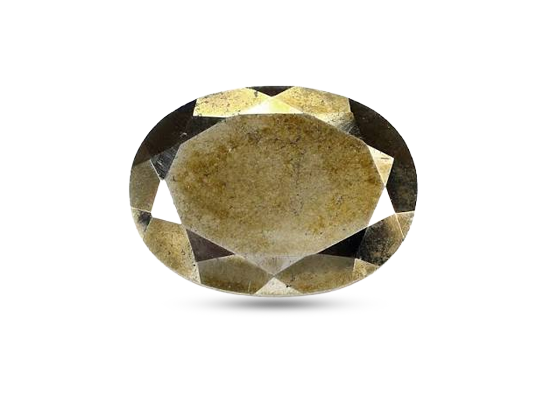
Pyrite is the stone that looks like metal. It has a pale brassy gold color and a bright mirror shine, and it grows in nature as almost perfect cubes, as if someone had cut them by hand. Miners mistook it for gold so often that it earned the nickname fool’s gold. In jewelry it gives a sparkle that is warm, a little vintage and quite unlike any colored gem. We set natural pyrite in 925 sterling silver and solid gold at our studio on Sukhumvit 71, Bangkok.
This page covers what pyrite is, how it differs from real gold, pyrite and marcasite jewelry, how it compares with lapis lazuli, onyx and black spinel, how to wear and care for it, what makes a good piece of pyrite, where it comes from, how to see the stones at our shop, and how to order in Bangkok or anywhere in Thailand.
What pyrite is
Pyrite is iron sulfide, a common mineral made of iron and sulfur. Its name comes from the Greek word for fire, because a piece of pyrite struck against steel or stone throws sparks. It forms in many kinds of rock, from old sea beds to the veins around ore deposits, and it often grows as sharp cubes, twelve sided crystals or glittering clusters.
It is opaque, so light does not pass through it. All of its beauty is in the surface: a metallic luster that reflects light like a polished coin. Cut into small faceted pieces it sparkles; left as a natural cube or cluster it looks like a tiny piece of architecture.
Pyrite is not treated. It is used just as it comes out of the ground, cut and polished, and every stone we set is natural, pyrite included. If a stone has had any treatment we tell you before you order.
Pyrite facts at a glance
- Family: iron sulfide mineral, opaque with a metallic luster
- Color: pale brassy yellow, sometimes with an iridescent tarnish
- Hardness: 6 to 6.5 on the Mohs scale, but brittle
- Treatment: not treated
- Best for: pendants, earrings and brooches; rings only for occasional wear
- Care: keep dry; wipe with a soft dry cloth; no water soaking, ultrasonic or steam cleaners
- Price: depends on the quality and carat you choose; we quote before you order
Fool’s gold and marcasite jewelry
Fool’s gold is an old miners’ joke. Pyrite and gold can look alike in a pan of river gravel, but they are easy to tell apart once you know how. Gold is soft and bends; pyrite is hard and breaks into sharp grains. Gold is a deep, rich yellow; pyrite is paler and brassier. Gold leaves a yellow streak when rubbed on rough porcelain, while pyrite leaves a greenish black one. Pyrite has no gold value at all, and we are always clear about that.
Marcasite jewelry is the classic way to wear pyrite. The name comes from a different mineral with the same chemistry, but the tiny faceted stones in vintage marcasite jewelry are almost always pyrite, because true marcasite is too unstable to last. Rows of these little stones set in silver were hugely popular in the Victorian era and again in the 1920s and 1930s, often paired with black onyx. In Thailand this style is well known in silver jewelry, and it still looks charming today.
Pyrite also turns up inside other stones. The gold flecks you see in good lapis lazuli are small grains of pyrite.
Pyrite and other dark or metallic stones
Lapis lazuli is deep blue with pyrite sparkling inside it like stars. If you love that touch of gold in the blue, the two stones work beautifully together in one piece.
Onyx is smooth and black, and it was the favorite partner of marcasite in Art Deco jewelry. The contrast of glossy black with bright metallic sparkle is still one of the most elegant combinations in silver.
Black spinel is a hard, faceted dark gem with a crisp sparkle, harder and better for daily rings than pyrite. Choose pyrite for its golden metallic look, and black spinel when you want a dark stone you can wear every day.
How to wear and care for pyrite
Pyrite is 6 to 6.5 on the Mohs scale, so it resists scratches fairly well, but it is brittle. A hard knock can chip a facet or crack a crystal, and the edges of natural cubes are easy to damage. That makes pyrite best for pendants, earrings and brooches. A pyrite ring is fine for evenings and special occasions in a protective setting, but it is not the right choice for a ring you wear every day.
The bigger issue is moisture. Over time, damp air, sweat and water react with pyrite and can make it dull, tarnished or even rusty, with a fine powder forming on the surface. So keep it dry. Take it off before you shower, swim or go to the gym, wipe it with a soft dry cloth after wearing, and store it in a dry box, ideally with a small silica gel packet. Do not soak it, and keep it away from ultrasonic and steam cleaners. If it ever needs a polish or a check of the setting, bring it to our shop. Maintenance is free on jewelry we made.
What makes a good piece of pyrite
Luster matters most. Good pyrite has a bright, even, mirror like shine with no dull or rusty patches.
Shape sets the style. Sharp natural cubes and clusters make bold, modern pendants; small faceted stones give the soft glitter of vintage marcasite; smooth cabochons and beads show a calmer metallic glow.
Condition is easy to check. Look along the edges and corners for chips and cracks, and at the surface for powdery spots, which are an early sign of decay.
Color is usually a pale brassy gold. Some pyrite shows a thin rainbow tarnish in blue and purple, which some people love; just make sure it is a natural film and not a coating that will wear off.
Where pyrite comes from
Pyrite is found all over the world. The most famous perfect cubes come from Navajún in northern Spain, where they sit in gray rock like dice. Peru is known for large, bright clusters, and Italy, China, the United States and Mexico also produce fine material. The small stones used in marcasite jewelry are cut in many places. If you want to know the origin of a particular stone, ask us: we offer certified stones, and an uncertified stone can be sent to a gem lab for a report at extra cost.
See pyrite at our shop in Bangkok
Pyrite is hard to judge from a photo, because its whole charm is the way the metallic faces catch the light as you turn it. If you tell us ahead that pyrite is the stone, we will have a few ready, from natural cubes to small faceted stones, and we can show you how it looks next to lapis lazuli and onyx.
Walk in any time we are open, or book ahead so Yaron is there to help with the stone, the design and the metal, from 925 silver and gold plating to solid 9K, 14K or 18K gold.
A sharp pyrite cube is lovely on a desk or a shelf as well as in jewelry. Loose pyrite is for sale with no jewelry order needed, and if you later want it made into a pendant or earrings, we are happy to set it.
See pyrite with Yaron
TOANOI House, 259/80 Phibunwet Village, Sukhumvit 71, Bangkok. Monday to Friday 9:30 to 17:00 and Saturday 10:00 to 15:00. We speak Thai, English and Japanese.
Not in Bangkok? Message us and we will send photos and prices of the pyrite we have.
Pyrite questions we get
Is your pyrite natural?
Yes. Every gemstone we set is natural, pyrite included, and pyrite is not treated. We are a member of the Thai Gem and Jewelry Traders Association.
Is pyrite real gold?
No. Pyrite is iron sulfide and contains no gold, which is why it is called fool’s gold. It is paler and harder than gold, and it breaks instead of bending.
Will pyrite tarnish or rust?
It can if it stays damp. Water, sweat and humid air slowly react with pyrite, so take it off before showering, swimming or exercise, wipe it dry and store it in a dry box.
Can I wear a pyrite ring every day?
We do not recommend it. Pyrite is 6 to 6.5 on the Mohs scale but brittle and sensitive to moisture, so a ring is best for occasional wear. Pendants and earrings are the easiest way to enjoy it often.
How much does pyrite jewelry cost?
It depends on the quality and carat of the stone you choose, and on the metal. We give you the price before anything is made.
Can I buy just the stone?
Yes. Pyrite can be bought by itself, as a loose stone or a natural cube, without a setting. If you want it made into a pendant or earrings, now or later, we are happy to set it.
How long does a pyrite piece take?
7 to 10 working days from your order, because the stones are already here in our shop, then 1 to 3 working days for delivery inside Thailand. We also ship abroad by FedEx.
Every pyrite piece is made to order by our team in Bangkok in 925 sterling silver or solid gold, with a 3-year warranty, free maintenance and free shipping across Thailand.
