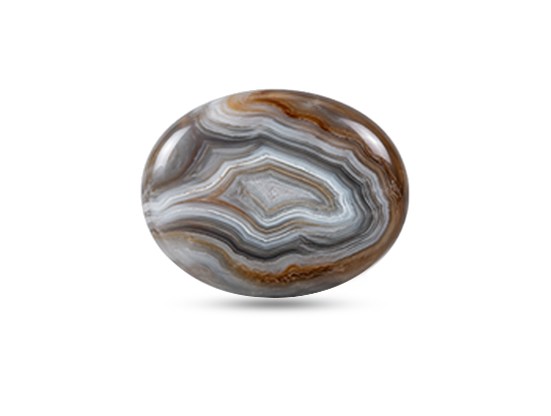
Agate is quartz that grew slowly, layer by layer, inside cavities in old volcanic rock. Cut it open and you find rings and bands of gray, white, honey brown and red, sometimes as fine as pencil lines, sometimes broad and soft like watercolor. No two slices share a pattern. It is one of the toughest and friendliest stones to wear, and people have carved it into seals, beads and rings for thousands of years. We set natural agate in 925 sterling silver and solid gold at our studio on Sukhumvit 71, Bangkok.
This page covers what agate is, natural and dyed colors, red agate and the other kinds you will meet, how agate compares with onyx, amethyst and lapis lazuli, how to wear and care for it, what makes a good agate, where it comes from, how to see the stones at our shop, and how to order in Bangkok or anywhere in Thailand.
What agate is
Agate is a banded form of chalcedony, which is quartz made of crystals far too small to see. Crystal quartz such as amethyst grows as one large crystal; chalcedony grows as a dense mass of tiny fibers, and that is why agate is tough rather than glassy. The name goes back to the Achates river in Sicily, where the ancient Greeks collected it.
The bands form when water rich in silica seeps into a gas bubble or crack in lava, again and again over a very long time. Each new layer carries a little more or a little less iron and other traces, so each layer takes a slightly different color and transparency. Some are hollow and lined with small amethyst crystals: the geodes you see cut in half at gem fairs.
Agate itself is always a natural stone, but its color is not always natural. Because the fine layers are slightly porous, agate takes dye very easily, and much of the bright blue, pink, purple and vivid green agate on the market has been dyed. We tell you before you order if a stone has been dyed or heated.
Agate facts at a glance
- Family: chalcedony, the fine grained form of quartz
- Color: natural gray, white, brown, honey and red in bands; blue, pink, purple and bright green are usually dyed
- Hardness: 6.5 to 7 on the Mohs scale
- Treatment: often dyed; red and brown agate is often heated; we always tell you
- Best for: rings, signet rings, pendants, bracelets, beads and earrings
- Care: warm soapy water and a soft cloth; keep dyed agate away from strong chemicals and long hours of sun
- Price: depends on the quality and carat you choose; we quote before you order
Natural colors, dyed colors and red agate
Natural agate comes in calm colors: smoky gray, milky white, cream, honey, brown, orange and red. In a natural stone the bands follow each other in a believable way, and the color is a little uneven from layer to layer, which is part of the charm.
Dyed agate shows colors that nature rarely gives this stone, such as electric blue, hot pink or bright grass green. Dyeing is an old, accepted practice, and dyed agate can be very pretty, but it should be sold and priced as dyed. Look closely at the bands: dye soaks into some layers more than others, so a dyed agate often has bands that are strongly colored next to bands that stayed almost white.
Red agate is one we carry, in warm brick, cherry and orange red. The red comes from iron in the stone, and heating is widely used to deepen it, the same way it is for much carnelian. When we show you red agate we tell you what we know about its color.
You will also hear of moss agate, clear with green plant shaped inclusions, blue lace agate, naturally pale blue, and fire agate, brown with a rainbow sheen. All are chalcedony.
Agate and other stones of the quartz family
Onyx is a close cousin. True onyx is chalcedony with straight, parallel bands, often black and white, and the solid black onyx in most jewelry is chalcedony that has been colored black. If you want a pattern, choose agate; if you want one clean color, choose onyx.
Amethyst is the same mineral grown as a single clear crystal, so it is faceted to sparkle. Agate is opaque or translucent and shows its beauty in its pattern, so it is cut smooth.
Lapis lazuli is the stone to choose if you want a deep, natural blue. A very bright blue agate is almost always dyed, while lapis owes its color to its own minerals.
How to wear and care for agate
At 6.5 to 7 on the Mohs scale, with no cleavage and a tight fibrous structure, agate is tough. That is why it has been used for signet rings, seals and cameos since ancient times. An agate ring is a good everyday choice, and agate also works well in pendants, bead bracelets and earrings.
Clean it in warm soapy water with a soft cloth, then rinse and dry. Natural agate is easy to look after. Dyed agate needs a little more care: keep it away from bleach, nail polish remover and other strong chemicals, and do not leave it sitting in a sunny window for months, because some dyes can fade. If it ever needs a polish or a check of the setting, bring it to our shop. Maintenance is free on jewelry we made.
What makes a good agate
Pattern matters most. Look for crisp bands with good contrast, or a pattern you simply love, such as an eye, a landscape or a soft cloud of color.
Placement decides how the pattern sits in the jewelry. When a cabochon is cut, the cutter chooses which part of the slice ends up in the center. A well placed pattern looks balanced from the front.
Translucency and polish bring it to life. Light passing into the top layers gives agate a soft glow, and an even polish shows the bands clearly.
Soundness is easy to check. Hold the stone to the light and look for cracks that run across the bands.
Where agate comes from
Agate is found on every continent. Brazil and Uruguay supply much of the agate in the trade, including the large geodes and the gray material that is often dyed. India has a long tradition of cutting agate beads and red agate, Botswana is known for soft pink and gray banded stones, and Mexico for crazy lace and fire agate. It also comes from Madagascar, Germany, the United States and China. If you want to know the origin of a particular stone, ask us: we offer certified stones, and an uncertified stone can be sent to a gem lab for a report at extra cost.
See agate at our shop in Bangkok
Agate is a stone you choose with your eyes, because every slice has its own pattern and the same color can look calm in one stone and lively in the next. If you tell us ahead that agate is the stone, we will have a selection ready, including our red agate and natural gray and white banded stones.
Walk in any time we are open, or book ahead so Yaron is there to help with the stone, the design and the metal, from 925 silver and gold plating to solid 9K, 14K or 18K gold.
If one agate catches you because of its pattern, you can take it home just as it is. Loose agate is for sale with no jewelry order needed, and if you decide later that it belongs in a ring or a pendant, bring it back and we will set it.
See agate with Yaron
TOANOI House, 259/80 Phibunwet Village, Sukhumvit 71, Bangkok. Monday to Friday 9:30 to 17:00 and Saturday 10:00 to 15:00. We speak Thai, English and Japanese.
Not in Bangkok? Message us and we will send photos and prices of the agate we have.
Agate questions we get
Is your agate natural?
Yes, the agate itself is always a natural stone. Many bright blue, pink, purple and green agates on the market are dyed, and red agate is often heated to deepen its color, so we tell you before you order if a stone has been dyed or heated. We are a member of the Thai Gem and Jewelry Traders Association.
How can I tell if an agate is dyed?
Very bright colors such as electric blue, hot pink or vivid green are a strong sign, and so are bands that are deeply colored next to bands that stayed almost white. Natural agate is gray, white, brown, honey or red. If you are not sure about a stone, ask us and we will tell you what we know.
What is the difference between agate and onyx?
Both are chalcedony. Agate has curved, often colorful bands, while onyx has straight, parallel bands, usually black and white. Most solid black onyx in jewelry is chalcedony colored black.
Can I wear an agate ring every day?
Yes. Agate is 6.5 to 7 on the Mohs scale and very tough, which is why it has been used for signet rings for centuries. Take it off for heavy work, and keep dyed agate away from strong chemicals.
How much does agate jewelry cost?
It depends on the quality and carat of the stone you choose, and on the metal. We give you the price before anything is made.
Can I buy just the stone?
Yes. An agate can be bought by itself, without a setting, and you can bring it back later if you want it made into a ring, pendant or earrings.
How long does an agate piece take?
7 to 10 working days from your order, because the stones are already here in our shop, then 1 to 3 working days for delivery inside Thailand. We also ship abroad by FedEx.
Every agate piece is made to order by our team in Bangkok in 925 sterling silver or solid gold, with a 3-year warranty, free maintenance and free shipping across Thailand.
